
'Vijay entered politics at a much better age compared to Rajnikanth and Kamal Haasan. His fans are young and he has at least 2-3 decades ahead of him.'

In focus are the assembly polls in 2026. From a BJP perspective, their attack on the ruling DMK, using the 'Hindutva' card, and Annamalai's targeting of both Dravidian majors on corruption has not worked, points out N Sathiya Moorthy.
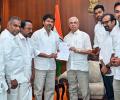
'Looking at the situation purely on its Constitutional merits, the governor's conduct is defensible.' 'He is saying: You do not have a majority, so prove it. That is not an unreasonable position even if the timing and the political context make it deeply controversial.'

The BJP often forgets that in Dravidian Tamil Nadu, the voter does not mix religion, which is personal, and politics that is in the public sphere, points out N Sathiya Moorthy.

Karnataka Home Minister G Parameshwara has ordered the CID to investigate the alleged kidnapping and murder of a real estate businessman from Anekal, whose body was found in Tamil Nadu. One person has been arrested, and the search is on for others involved in the crime.
Tamil Nadu Chief Minister and Dravida Munnetra Kazhagam president M K Stalin on Friday asserted that "there will be no rest" until amending the Constitution to fix timelines for governors to clear bills.

Tamil Nadu Chief Minister M K Stalin on Saturday claimed that Governor R N Ravi 'insulted' the gubernatorial position he holds, by not reading out the speech at the commencement of the assembly session.

Gehlot had on Wednesday refused to deliver the address to the Karnataka legislature, leading to a stalemate over the fate of the customary speech that outlines the government's policies.

The actor-turned-politician did not suffer any injury in the incident.

The government has released a set of FAQs to address concerns and clarify the details surrounding the Women's Reservation Bill, which aims to provide 33 per cent quota for women in legislatures.

Tamil actress Trisha Krishnan issues a strong response to 'inappropriate' comments made by a BJP leader, asserting her neutral political stance amidst controversy linking her to actor Vijay.
Tamil actress Trisha Krishnan issues a strong response to 'inappropriate' comments made by a BJP leader, asserting her neutral political stance amidst controversy linking her to actor Vijay.

The INDIA bloc faces challenges after recent state election defeats for key members like TMC and DMK, potentially shifting internal dynamics and leadership considerations.

PMK leader Anbumani Ramadoss has urged Prime Minister Narendra Modi to implement a legislative ban on the sale of cigarettes to individuals born on or after January 1, 2009, aiming to create a smoke-free generation in India.

Union Home Minister Amit Shah has announced a significant increase in Lok Sabha seats for the five southern states following delimitation, countering misinformation and clarifying the timeline for women's reservation implementation.

The Indian government and opposition parties are set for a showdown in Parliament over a Constitution amendment bill concerning the implementation of the women's quota law and the delimitation exercise. The Opposition is concerned about the potential impact of delimitation on the political representation of southern states.

Stalin's personal intervention in the Adheenam row may have contained the avoidable political damage and social tensions at least for now, observes N Sathiya Moorthy.

Senior DMK leader I Periyasamy reiterated that Chief Minister M K Stalin is firm against sharing power with allies, dismissing any possibility of a coalition government in Tamil Nadu.
For quite some time, there was speculation that actor-politician Kamal Haasan-led Makkal Needhi Maiam and the DMK would sign up with the strategist for the 2021 assembly polls.

Stalin said one cannot and should not decide the mood of the entire country based on the results of one state elections.

The Chhattisgarh government has introduced a bill aimed at preventing religious conversions through force, inducement, or misrepresentation, sparking opposition and debate in the state assembly.

The BJP continuing to look at the Dravidian polity through the religious prism has not worked in Tamil Nadu whereas it has yielded political and electoral results across much of the rest of the country, observes N Sathiya Moorthy.

The Supreme Court on Thursday struck down the 10.5 per cent reservation provided to Vanniyars, a Most Backward Community (MBC) in Tamil Nadu, in government jobs and admission to educational institutions.

The Tamil Nadu government today decided to abolish Common Entrance Tests for admission to professional courses.

Union Parliamentary Affairs Minister Kiren Rijiju announces the debate and vote on the no-confidence motion against Lok Sabha Speaker Om Birla will occur on March 9. The Budget Session's second part will also address important legislation and critical bills.

Rulers in New Delhi and their political aides in sensitive states like Tamil Nadu have to be doubly careful not to provoke a situation whose consequences may be much more than visible now to the naked eye, notes N Sathiya Moorthy.

'We will give Rs 25,000 to parents having a second child or more at the time of delivery itself.'

The BJP and the Opposition have engaged in a war of words over the implementation of the women's reservation bill, which aims to reserve seats for women in legislatures. The bill was defeated in the Lower House, leading to accusations and counter-accusations between the parties.
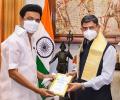
The DMK feels its genuine gestures have had no bearing on the governor's politico-administrative conduct, which is 'more political and politicised than administrative and Constitutional', observes N Sathiya Moorthy.

In a statement in the House, the chief minister said air ambulance service would be started at a cost of Rs 10 crore to transport critical patients to hospitals.

''Women are coming into public spaces in larger numbers than ever before. They are educated, capable, opinionated, and determined.' 'But the more women push for access to public space, the harder they are pushed back -- through attacks like this, through discrimination, through the glass ceiling, through the deliberate denial of recognition.'
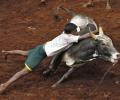
In a relief to Jallikattu supporters, the Supreme Court on Tuesday refused to stay the new legislation passed recently by the Tamil Nadu assembly but warned the state government not to allow commotion on the streets, reminding that law and order was its prime duty.
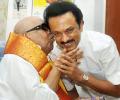
'With the deaths of Jayalalithaa and Karunanidhi, the BJP and Congress thought that they had a chance.' 'They have conceded that power is with the Dravidian parties.'

Several opposition parties on Wednesday decided to jointly oppose the delimitation provisions in the Constitution amendment bill in Parliament, even as they reiterated support for women's reservation, with Mallikarjun Kharge alleging the move is politically motivated.
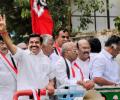
With election campaign ending in Tamil Nadu before it goes to polls on Thursday, N Sathiya Moorthy lists a few questions uppermost in the minds of voters.
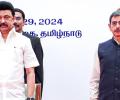
'It makes law-making on the part of the state governments much more difficult and throws up bottlenecks as governors are not acting on bills.'
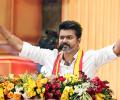
Actor-politician Vijay announced his retirement from cinema at the audio launch of his movie 'Jana Nayagan' in Malaysia, citing his dedication to his fans. The event, attended by nearly 1 lakh fans, featured emotional speeches and performances, marking Vijay's farewell before his political career.

M Karunanidhi was a masterful practitioner of modern-day politics, wielding considerable influence beyond his own state, in the corridors of power in New Delhi, for a long time and sewing up alliances with both the Congress and the Bharatiya Janata Party.
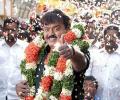
Vijayakanth's DMDK may play a key role as Tamil Nadu's political parties scramble for allies to capture the state's 40 Lok Sabha seats.

In its resolve to put an end to the "colonial mindset" of elite clubs and others in banning entry of people wearing traditional attire "dhoti", Tamil Nadu government on Wednesday introduced a bill in the state assembly, which seeks to make such practices a cognisable offence.
 © 2026 Rediff.com - Advertise with us - Disclaimer - Privacy Policy - Sitemap - Feedback - About us - Terms of use - Grievances